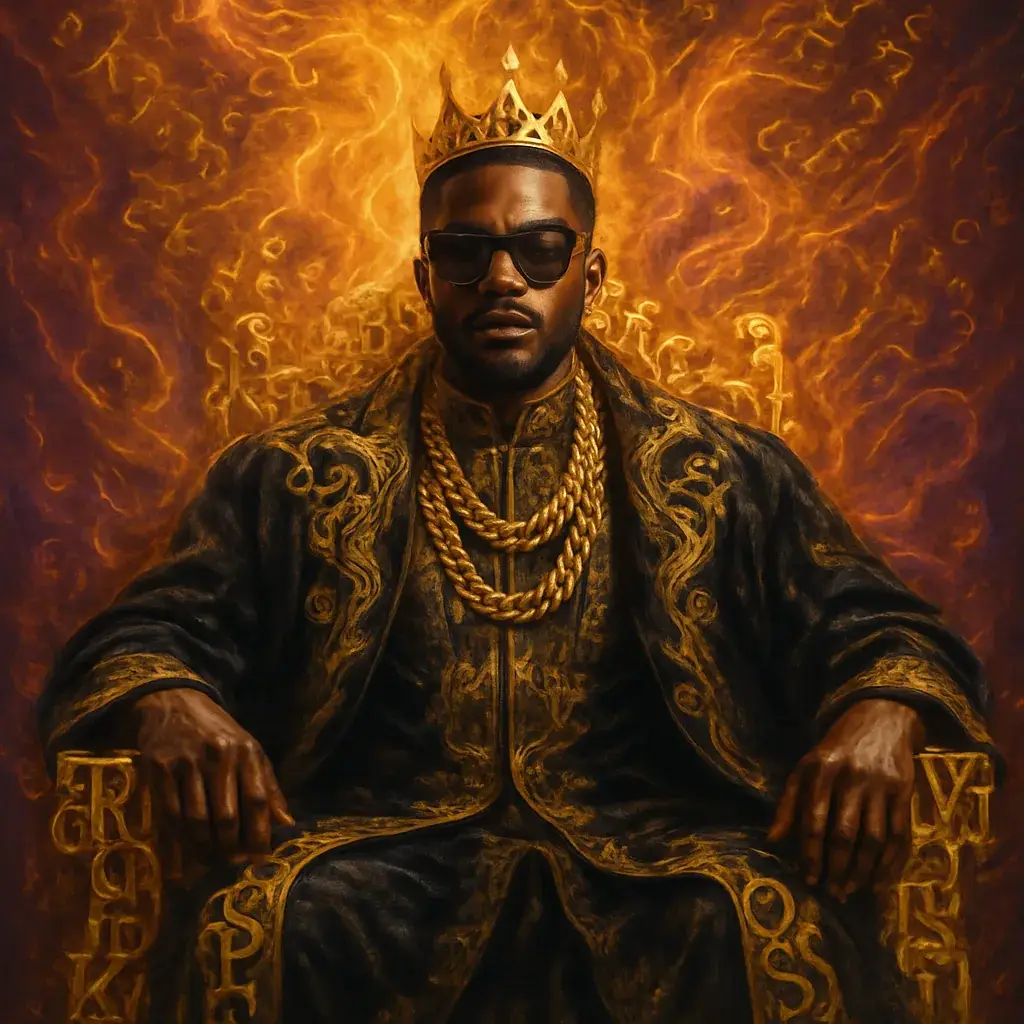
Explores the transmutation of "nigger" to "nigga," analyzing its historical weight, the act of reclamation as self-definition, and its significance as the starting point for the journey to kingship.
What’s the first thing that hits you when you hear the word "nigga"? Be real. Anger? Discomfort? Or maybe… nothing much? Maybe it’s just background noise, part of the everyday soundtrack. See, that’s the complexity of this word. It’s heavy. Loaded like a shotgun. It’s layered, cracked, polished, sharp, smooth – all at the same damn time. And like it or not, for better or worse, it’s ours now. You feel me?
But here’s the question that needs asking, loud and clear: Who holds the power over its meaning? Us or them? ‘Cause if it’s them, if we just let history dictate the narrative, then “nigga” will forever be chained to its ugly ancestor, “nigger” – a word soaked in blood, chains, and centuries of hate. But what if we decide? What if we seize control, perform that alchemy, reclaim it, redefine it, strip off the weight and make it light? What if we flip the whole goddamn script?
That right there? That’s the power of transmutation. It’s taking the very weapon designed to break our spirit and forging it into something different, something untouchable, something ours. This ain’t about erasing the past – nah, we honor the struggle, feel the weight, carry the history. But it damn sure doesn’t get to define us anymore. That’s what we did with "nigga." This wasn’t accidental. Wasn't some unconscious drift. It was deliberate. Strategic. It was resistance wrapped in defiance, disguised as a single word.
The Weight of History: Forging Chains with Words
To truly grasp the power of this reclamation, you gotta look unflinchingly at the source, the painful roots. We talkin’ "nigger," with the hard "er." That word wasn't born hateful. It crawled out of Latin, French, Spanish, just meaning "black," a simple descriptor when it first hit English centuries ago. But in the crucible of American slavery, it got twisted, forged into a weapon. By the late 1700s, it wasn't just a descriptor; it was a slur, pure and simple. Through the hell of slavery and the suffocating bullshit of Jim Crow, "nigger" became the ultimate tool of verbal oppression. It was the soundtrack to lynchings, the justification for segregation, the bedrock of racist caricatures designed to paint us as lazy, ignorant, dangerous, less than human – the Coon, the Brute. It wasn't just an insult; it was a systematic attempt to dehumanize, to strip away identity, to reinforce a brutal power structure. They tried to brand our souls with it.
But even in that inferno, some spirits refused to break. Think about it. Who got called "nigger" the loudest, the most viciously? Yeah, often it was just for existing while Black. But specifically? It was weaponized against the ones who resisted. The rebels plotting escape, the ones refusing to bow, the ones looking the master straight in the eye with defiance instead of fear. They were labeled "nigger" precisely because they were rebellious, stepping outside the lines, ignoring the rules of the slave master. Their perceived "ignorance," in the twisted logic of the oppressor, was their refusal to accept subjugation, their refusal to stay in the box assigned to them. That spirit – that defiant, unbreakable will – planted a seed, even within the poison of the word itself.
The Shift: From Poison to Power
Generations passed. Within the sanctuary, the proving ground, of Black communities, something profound started happening. A linguistic and psychological alchemy began. The word, once only used to harm, started to shift. We didn't erase it; we took it. Stripped it of its intended destruction. Redefined it from the inside out. That’s transmutation – turning lead into gold, pain into power.
"Nigga," often with that softened ending, emerged. Distinct in sound, absolutely distinct in context and intent. It became a symbol – of survival against all odds, of raw authenticity in a world demanding masks, of resilience forged in fire. It became ours to reclaim, a badge of defiance worn not with shame, but with a complex pride. It's a prime example of what linguists call linguistic reappropriation – a marginalized group taking back the verbal weapons used against them, flipping the power dynamic. Sometimes the goal is value reversal, making it positive. Sometimes it's neutralization, stripping its power to harm. Sometimes it's stigma exploitation, wearing the label defiantly to expose the original injustice. "Nigga" arguably does all three, depending on who's using it, how, and why.
The Meaning Now: It's About Us
And yeah, I know the debate still rages, even amongst us. Some brothers and sisters refuse the word entirely, arguing it's irredeemable, forever tainted by the trauma, that using it only perpetuates the harm or normalizes it for others. They see the scars, feel the weight, and believe some words should be buried. And that perspective, born from deep pain, deserves nothing but respect. Others wield it daily – a term of endearment for their day ones, a declaration of shared struggle and power, a marker of in-group solidarity.
Then you got the outsiders, especially white folks, still trying to police our language, getting bent out of shape, asking if they can say it. (Spoiler alert revisited: Still nope. You ain't earned it.) Their confusion, their discomfort, their attempts to control the narrative – it all misses the point.
Because here’s the damn thing: "Nigga" today isn’t about them. It’s about us. How we use it. How we feel it. It’s our internal code, our cultural touchstone. When I say "nigga" to my brother, I ain’t invoking the whip or the chains. I’m invoking connection. Freedom. Brotherhood. Shared understanding forged in the same fire. It's about claiming the unclaimable, taking ownership not just of a word, but of our damn selves and our complex history.
It's that alchemist shit again. Black folks taking the ugliest parts of the American experience and making art, making music, making beauty, making meaning. Turning "nigger" into "nigga" – that ain’t just changing a letter. It’s changing the energy. It’s a vibe. It’s a language. It’s family. It’s a testament to our resilience, our creativity, our power to innovate even with the scraps they threw us. Transforming a tool of degradation into a symbol of solidarity – that's profound.
Self-Definition: The Core of Kingship
But don’t get it twisted. This ain’t about sugarcoating or saying the word lost all its danger. It didn't. This is about power. About choice. About the fundamental right to self-definition. It’s about looking history and the powers that be in the eye and saying, “You don’t get to define me. I define me.” That’s the core. The bulletproof truth. It’s seizing control of your narrative, your identity, your destiny. It’s recognizing that words have power, yeah, but we have the power to wield them, reshape them, make them serve us. This act asserts autonomy and competence, fulfilling fundamental human needs according to Self-Determination Theory. It’s Empowerment Theory in action – using language as a tool to challenge stigma and increase self-efficacy. It's cognitive reframing on a collective level.
It's still complex. Still messy. That awkwardness when the word hangs in mixed company? It highlights its nature as an internal code, a language forged in shared experience, often misunderstood or misused by those outside the circle. But that complexity doesn't negate its power for those within. This ongoing linguistic struggle mirrors the larger journey towards kingship – taking control, defining oneself against external pressures, confronting historical burdens, asserting agency.
Freedom, Expression, and the Path Forward
And that rebellious spirit baked into the history of "nigger"? It lives on in the freedom of "nigga." It connects to that strategic "ignorance" – not lack of knowledge, but a conscious disregard for oppressive norms, a refusal to be boxed in. It’s the freedom to be unapologetically you, whether it’s your hairstyle, your clothes, your way of speaking truth. It’s rejecting societal molds, like sagging pants being more about style than some fabricated meaning, and saying, "This is who I am. This is how I move. Deal with it." It’s expressing yourself fully, not bound by their standards of "civil" or "politically correct." Being a nigger, in this reclaimed sense, is a powerful sense of freedom.
Now, we choose what it means. We define it. And for those who get it, who feel it in their bones, it’s a symbol of resilience, defiance, us. But the journey doesn't stop here. This ain't about staying locked in that "nigga" identity, however powerful its reclamation. True freedom, true kingship, demands the next transmutation. Taking that raw authenticity, that rebellious fire, and evolving it into something even greater: Leadership. Wisdom. Impact. Building something new.
So, if you leave this chapter with nothing else, leave with this: The power was never solely in the word itself. The power resides in us. In our ability to reclaim, redefine, transmute. The way we take history’s dirt and grow flowers anyway. That process? That’s the foundation. That’s the alchemy. That’s the first defiant step toward kingship. That’s stepping into your own goddamn power.
And if that makes some people uncomfortable? Good. Growth is never comfortable. Embrace the complexity. Own the power. Now, sit with this, because we’ve got a kingdom to build.